
Next Gen Scholars presented their research on Ghana’s Urban Mobility at the University of Ghana
In early November, the Next Generation PhD. Scholars of PRISM's Ghana Living Lab presented their research plans at the University of Ghana, focusing on innovative mobility solutions and regulatory challenges. Their work addresses ride-hailing governance, three-wheeler mobility services, and perceived accessibility, contributing to equitable and sustainable urban transport systems in Ghana.
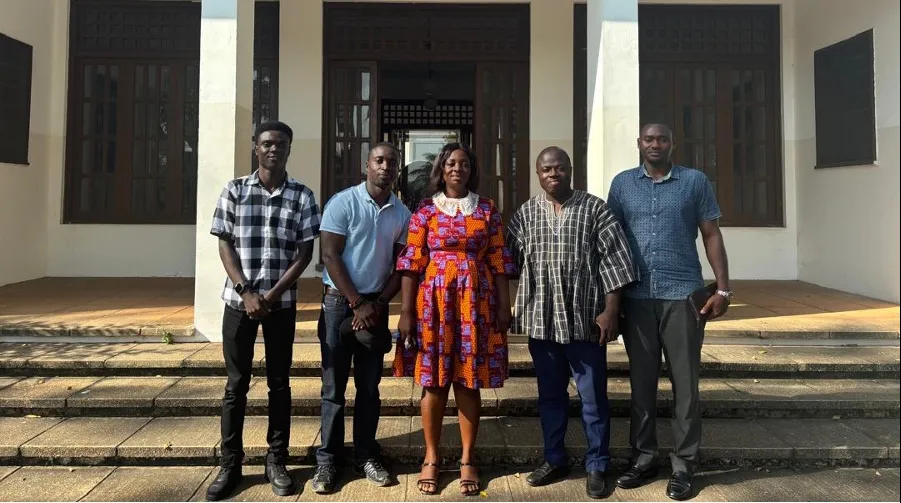
In early November, Next Generation Scholars within the Ghana Living Lab of PRISM participated in a research seminar event held at the University of Ghana, where they presented their research ideas and plans for the first time. In this article, Augustina, Solomon and Dominic explain:
- What their research is about.
- Why the research is important.
- How they intend to go about it.
- What they hope to find out and contribute.
- Any expected challenges.
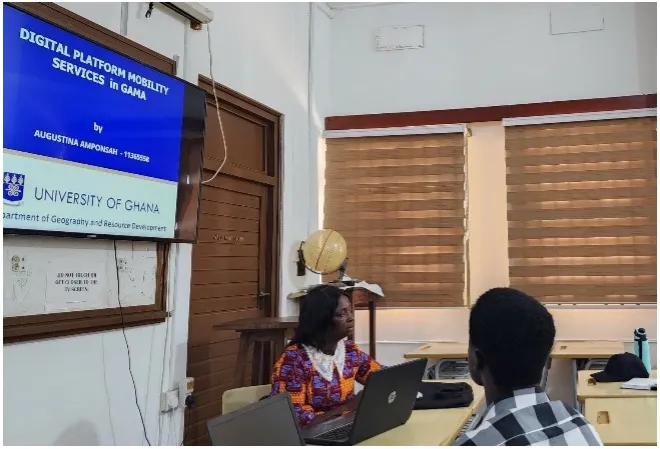
Augustina Amponsah— PhD researcher, focused on the policy and regulatory response to digital platform mobility services.
My research focuses on the regulatory environment for ride-hailing services in Ghana, examining how policies are shaped, enacted, implemented, and enforced. By studying the current governance structures, the research seeks to identify strengths and gaps in existing regulations, particularly in areas such as operational permitting and licencing, driver standards, fare regulation, safety, and data privacy. Additionally, the study will consider perspectives from stakeholders including government agencies, ride-hailing companies, drivers, and passengers to develop a comprehensive view of the sector. This research is part of the Accra \Kumasi living Lab which seeks to synergize transport for equitable mobility.
As ride-hailing services expand, they bring substantial economic and social benefits, including job creation and increased mobility options for the public. However, they also introduce challenges such as market competition with traditional taxis, fare disputes, and safety concerns. Effective policies are crucial to ensure fair treatment, protect public interests, and foster sustainable growth in the sector. This research is essential to help policymakers in Ghana make informed decisions that balance innovation with regulation, ultimately leading to a safer, more equitable ride-hailing environment for all.
To gain in-depth insights into the governance of ride-hailing in Ghana, I plan to use a mixed-method approach. I will conduct interviews with key stakeholders, including government officials, representatives from ride-hailing companies, drivers, and passengers. Additionally, I will review existing policies, laws, and case studies from other countries to understand how similar challenges have been addressed elsewhere. Both qualitative and quantitative analysis will be used. I will examine patterns, such as common regulatory challenges and the responses of ride-hailing companies. This analysis will include comparing fare regulation models, safety protocols, and licensing requirements.
Through this research, I hope to identify policy and regulatory gaps and highlight areas where current policies may be lacking or insufficient for the unique needs of the ride-hailing industry. I will elicit stakeholder perspectives to gain insights into the motivations and concerns of all parties involved, from government bodies to drivers and passengers. Based on findings, I aim to propose evidence-based recommendations that can improve ride-hailing governance in Ghana.
This research is not without its challenges. Some anticipated obstacles include securing interviews with government officials and ride-hailing company representatives might be challenging due to time constraints and potential unwillingness to share sensitive information. Access to comprehensive data on ride-hailing activities and user statistics may be limited, especially with data privacy concerns and limited local research on the topic. Policies governing ride-hailing services are constantly evolving. Navigating these changing regulations, especially in an emerging economy like Ghana’s, adds complexity to the study. Reconciling differing perspectives—such as those of drivers who may favour fewer regulations versus passengers who may prioritize safety—will require nuanced analysis to ensure balanced recommendations.
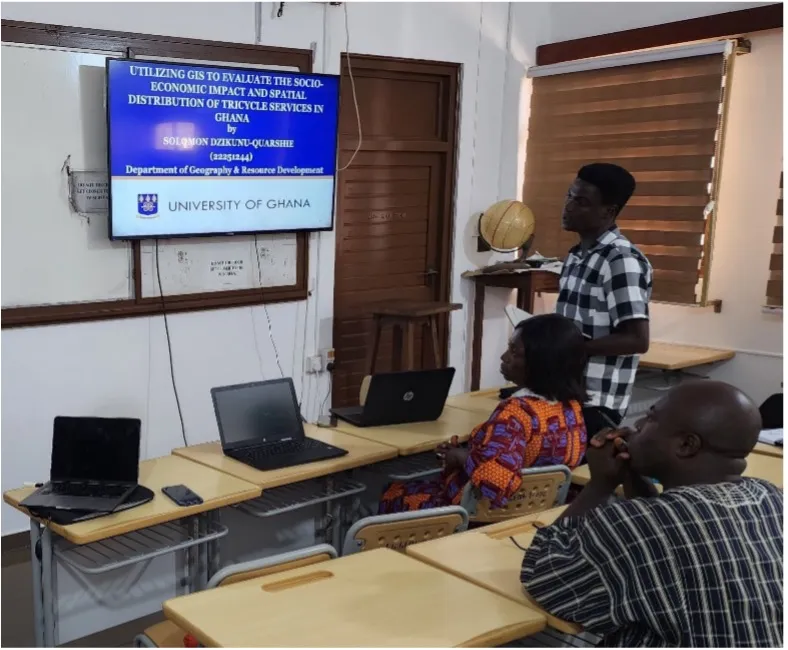
Solomon Dzikunu-Quarshie— MSc in Geographical Information Science, dissertation investigates the spatial distribution and operational characteristics of three-wheeler mobility services
Using GIS, my research evaluates the spatial distribution of and operational characteristics three-wheeler mobility services, also known as “Pragya,” in the Greater Accra Metropolitan Area (GAMA). Pragya have emerged in urban transport ecosystem to fill a void in people's access to resources and services. With its growing popularity in Africa particularly in Ghana, I am interested in identifying the hotspots of Pragya usage, particularly aiming to understand where these services are located and operate from, their routes, and whether they are effectively addressing urban transportation needs. This study is part of the larger Accra/Kumasi Living Lab project, which aims to understand the interactions between various transport options and their accessibility impacts.
This research vital for understanding the evolving landscape of urban transport. Pragya have become a popular and accessible mode of transport filling voids left by traditional public transport. Nevertheless, little is known about their spatial distribution, pattern of usage, and overall impact on urban mobility and accessibility. This study will map these tricycles' locations and modes of operation, yielding vital information that can inform transportation planning, promote accessibility to resources and services, and improve traffic flow.
Using participatory mapping techniques, I intend to learn more about the locations and modes of operation of tricycles, pinpoint well-travelled routes, and evaluate their effects on mobility. This approach will also include gathering GPS data while travelling, interviewing drivers, and working with local communities to map transportation experiences and needs. Most importantly, I want to ascertain whether Pragya are successfully addressing transportation gaps in underserved areas. This data will support the living lab's objective of creating an equitable, accessible, and integrated urban transit system that satisfies the many demands of the people of Accra and Kumasi. Ultimately, the results of this study will help guide the development of policies that will make Ghana's urban transport networks safer, more effective, and more inclusive.
Accurate data collection and mapping of the three wheeler vehicles’ operational bases, routes and service coverage is expected to be challenging and time-consuming. I am hoping that my local knowledge of the study area would be of some benefit here as a starting point. I will also be counting on the willingness of operators of these services to participate in my research and help to generate the data I need for this study.
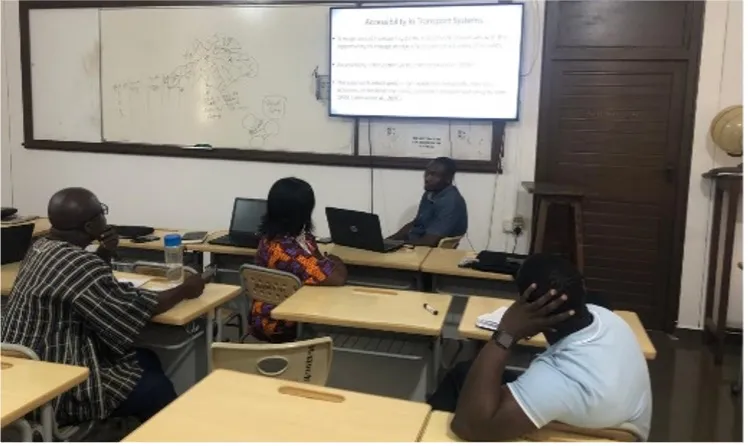
Dominic Edem Hotor—Research Associate, focused on developing methods to assess perceived accessibility impacts of ride-hailing and Pragya services.
I have recently completed my PhD at the University of Ghana. Within PRISM Ghana Living Lab, my current research is contributing to how to measure and assess the accessibility impacts of ride-hailing and Pragya as new mobility options in Ghana’s urban transport and mobility ecosystem, using the concept of Perceived Accessibility. Perceived Accessibility reflects not just physical access but also users’ subjective experiences, such as convenience, affordability, and safety. Analyzing perceived accessibility offers insights beyond just physical availability or fare costs and captures users’ experiences with the accessibility of these mobility services to opportunities and destinations that matter to them. This information is vital for urban planners and policymakers in addressing the transport needs of diverse populations and ensuring that transport infrastructure truly supports social and economic equity within these rapidly urbanizing regions.
As part of this process, I am reviewing literature on Perceived Accessibility as a concept which will then inform the design of a survey instrument specific to Ghana’s urban context. Ultimately, I will develop an instrument adapted to capture local perceptions of convenience, affordability, safety, and satisfaction with ride-hailing and Pragya services. By capturing users’ perspectives, the findings will contribute to the Living Lab’s mission of designing an integrated, accessible, and equitable urban transport system that meets Accra and Kumasi’s diverse needs.
I anticipate some challenges, particularly in balancing subjective perceptions with objective data. Perceptions of accessibility can be very personal, influenced by individual circumstances, past experiences, or social factors, and capturing this range of experiences in a standardized survey format can be tricky. Another challenge is reaching a broad, diverse demographic, including low-income residents and people with disabilities, who may face unique transport needs. Adapting survey tools from global north contexts to fit Accra and Kumasi will require careful language and framing adjustments, including translations into Twi and Ga for local relevance. These may seem quite daunting at the moment, but I am actually excited and motivated by the methodological innovation that this work would contribute and I am looking forward to seeing the data and insights that will be gathered with the instruments I am helping to develop.