
Graduate Research Academy 2026: Call for Participants!
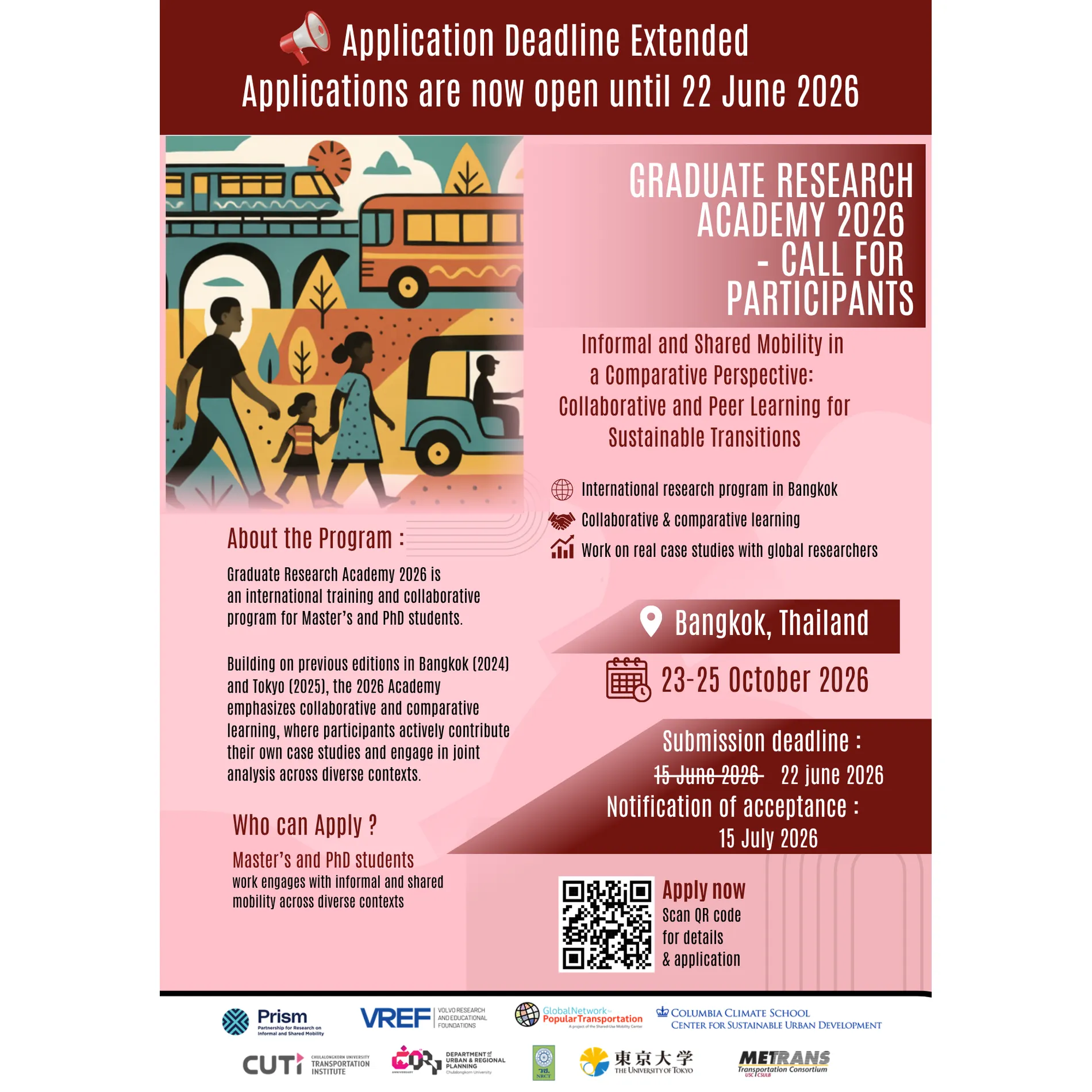
Graduate Research Academy 2026 - Deadline Extended!
Informal and Shared Mobility in a Comparative Perspective: Collaborative and Peer Learning for Sustainable Transitions
Graduate Research Academy 2026 is an international training and collaborative program for Master's and PhD students organized by Chulalongkorn University Transportation Institute (CUTI) in collaboration with the Partnership for Research on Informal and Shared Mobility (PRISM), Department of Urban and Regional Planning (CUURP), Faculty of Architecture at Chulalongkorn University, the University of Tokyo, and University of Southern California.
The Graduate Research Academy 2026 is the third edition of an international training and collaborative program for Master’s and PhD students. The first Graduate Research Academy was held in Bangkok in 2024, focusing on strengthening core research skills and methodologies. In 2025, the program was hosted in Tokyo, where participants explored innovations in sustainable urban transport using participatory foresight approaches. Building on these experiences, the 2026 Graduate Research Academy places greater emphasis on collaborative and comparative learning, where participants actively contribute their own case studies and engage in joint analysis across diverse contexts.
Focus and Theme
This year’s program focuses on informal and shared mobility (ISM). ISM encompasses a wide range of motorized and non-motorized transport services, including two- and three-wheelers, minibuses, and other locally adapted modes (e.g., motorcycle taxis, tuk-tuks, jeepneys, and matatus). These systems serve as a primary mode of travel for millions of people across the Global South. They are central to everyday mobility and increasingly important to debates on inclusion, sustainability, and low-carbon transport transitions. At the same time, these systems face complex challenges related to governance, labor conditions, integration, public health, and long-term sustainability. Addressing these challenges requires context-sensitive and comparative approaches—an orientation that lies at the core of this year’s Academy. Accordingly, rather than a traditional classroom setting, the program is designed as an interactive and participant-driven environment, where participants are not only learners but also co-producers of knowledge. Participants will work together to compare cases, exchange perspectives, and reflect on how different social, institutional, and spatial contexts shape mobility systems and transitions. They will also receive guidance and mentorship from researchers and practitioners at leading universities and institutions across different countries working on informal and shared mobility.
The 2026 edition focuses on informal and shared mobility (ISM) across diverse urban and regional contexts. We welcome case studies that engage with, but are not limited to, the following themes:
- Digitization and platformization
- Livelihoods, labor, and capacity development
- Governance, regulation, and political economy
- Gender, inclusion, and equitable access
- Low-carbon transitions and environmental impacts
- Public health and safety
- Integration with public transport and other mobility modes
Who Should Apply & Process Details
We invite Master’s and PhD students working on ISM across diverse geographic and thematic contexts to apply.
Applicants should:
- Be currently enrolled in a graduate program at the time of application
- Be working on a specific ISM-related case study
- Have access to empirical material (e.g., fieldwork, data, or documented experience)
- Demonstrate interest in comparative analysis and collaborative work
Applicants are required to submit:
- A CV (maximum two pages)
- A completed case study proposal using the official template
- Download the official template here: GRA 2026 Official Template
Selection Criteria:
The selection process aims to ensure a diverse and interdisciplinary cohort of participants. Selection will be based on:
- The quality and clarity of the submitted case study
- Relevance to the Academy's thematic focus
- The potential for comparative contribution across different contexts
- The applicant's motivation and potential to actively contribute to the program
Selected participants will:
- Present and discuss their case studies in a collaborative setting
- Engage in comparative group work with other participants
- Contribute to the development of joint outputs, such as early drafts of:
- Comparative academic papers
- Policy briefs
- Joint research proposals
(Participants are not expected to produce finalized outputs during the program.)
The Academy is organized in connection with the inaugural Global Convening on Informal and Shared Mobility (GloCon), to be held on October 26–28, 2026, in Bangkok, Thailand. Participants are strongly encouraged to attend GloCon, where they can engage with a broader international community of researchers, practitioners, and policymakers, offering opportunities to expand their networks beyond the Academy.
How to Apply
Please complete your application by submitting the required documents via email to [email protected] Your application should include the following documents:
- A case study submission using the official template (download template at: GRA2026_Template)
- A short CV (maximum 2 pages)
- Please use the following format for your email subject line:
GRA2026_[FirstName]_[Country]
(e.g., GRA2026_Ornicha_Thailand)
The deadline for submission is 15 June 2026 22 June 2026.
Key Dates
- 15 April 2026: Call opens
- 22 June 2026: Submission deadline
- 15 July 2026: Notification of acceptance
- 31 July 2026: Confirmation from participants
- 23-25 October 2026: Graduate Research Academy 2026
- 26-28 October 2026: Global Convening on Informal and Shared Mobility
Financial Support
Participation in the Graduate Research Academy is free of charge. However, participants are expected to cover their own travel and related expenses unless otherwise indicated. For all selected participants:
- Accommodation in Bangkok will be provided for up to 6 nights (22–27 October 2026)
- Breakfast will be provided at the hotel
- Lunch will be provided during the Graduate Research Academy sessions (23–25 October 2026)
- A welcome dinner will be organized during the program. Other dinners are not included
- For a limited number of participants: Partial travel support may be available, subject to budget availability
Financial support will be allocated on a competitive basis, taking into account factors such as need, geographic diversity, and the overall composition of the cohort. Selected participants may still be required to cover part of their travel and subsistence costs. Final decisions regarding the allocation and level of support will be made by the organizing team.
Contact
For questions or further information, please contact: [email protected]
Participants are responsible for obtaining the appropriate visa for entry into Thailand (if required). Visa requirements vary by nationality; please refer to the official Thailand e-Visa website for general information and application procedures: https://www.thaievisa.go.th/. If the e-Visa option is not available for your nationality or location, please contact your nearest Royal Thai Embassy or Consulate.